Beauty: God’s Messenger (2)
By Peter Kwasniewski | 3 December 2025
This article follows Beauty: God’s Messenger (1). This interview with Dr Kwasniewski first appeared in Calx Mariae issue 1 (Winter 2018)
CALX MARIAE: How would you describe your own discovery of Catholic tradition and what effect did it have on your formation and work?
PETER KWASNIEWSKI: For me, the discovery of Gregorian chant was a huge revelation. I can’t say why I was so fascinated by it at the tender age of 17, but then again, the chant really is mesmerising and haunting in a way that no other music is. By listening to recordings of the Wiener Hofburgkapelle, I taught myself to read the neumes in an old Graduale Romanum that had been discarded by the Benedictine boys’ school I was attending at the time. I think my study of composition — being introduced to J S Bach’s chorales and trying to imitate them in my exercises — also played a role: there is something about this kind of discipline that helps the mind to perceive beauty not as something vague, fluffy, and sentimental, but as the result of labour, craft, rule.
Other important influences at the end of high school included the reading of Plato’s dialogues and Ludwig Ott’s Fundamentals of Catholic Dogma. At the time, I felt that Plato, though a pagan, was really “one of us” — a sort of “closet Catholic”—– and that to be educated meant to read Plato, and authors like him. All this made me want to go to a college where I could be steeped in the riches of Catholicism that I had begun to taste. That’s why I went to Thomas Aquinas College in California, where I could study the “Great Books”.
Attending TAC introduced me to a world of immense depth and beauty. This included the traditional Latin Mass, where all that is purest, loftiest, and loveliest in the Catholic Faith comes to roost. I think of that psalm verse: “Even the sparrow finds herself a home, and the swallow a nest for herself, where she may lay her young: Thy altars, O Lord of hosts, my King and my God.” (Ps 83:4 [84:3]) The Mass truly was and must once again become the inspiring force of Catholic culture. Certainly for me and my family, it has been the place where we can make a spiritual home, and where we may bring up our young in the peace and fragrance of Christ.
CM: So much of modern culture is ugly, even grotesque, many people have a real hunger for what is beautiful and good. Can you suggest how we may satisfy this hunger?
PK: I strongly believe, as I hinted earlier, that we need to surround ourselves with beauty. I don’t mean in a cluttered or kitschy way, but by suitable decorations, by investing if we can in works of art, by listening to really good music (and by this, I do not mean any particular period, but certainly not pop, rock, rap, techno, or any of that barbaric stuff, which is the musical equivalent of junk food or drugs), and by seeking to understand the greatest art that European and Catholic civilisation has bequeathed to us. I would recommend several practical steps.
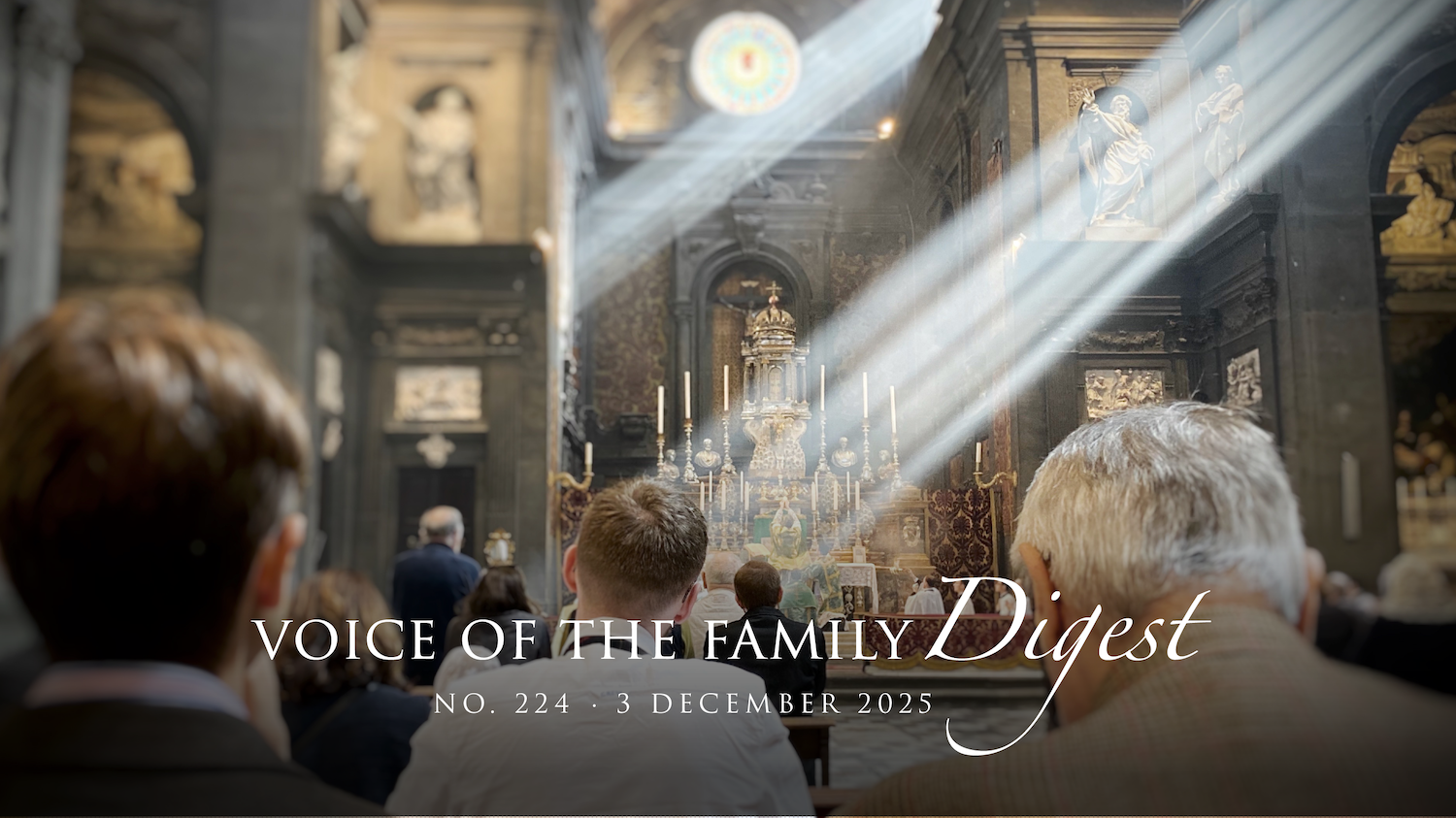
First, find the most beautiful celebration of the liturgy you can, and go to it. If it’s in a beautiful church, even better! The liturgy is where most of the fine arts blossomed and where they are meant to be experienced: as offerings to God, caught up in (and ideally assisting in) the ascending movement of prayer. The liturgy is not just the “source and summit” of the Christian life, it is also — or it has been and should once again be — the source and summit of Christian culture as well.
Second, think about the rooms you are living and working in, and how you might elevate them with prints, watercolours, engravings, etc. It takes time to find works of “original” art, but in the meantime, or supplementally, a good quality giclée reproduction of a Fra Angelico or a Giotto, a Rembrandt or a Vermeer can make a big difference in the ambience, encouraging a more contemplative spirit. (I recommend The Catholic Art Company, which has a fine selection. They don’t sell junk, and they don’t support immoral causes.)
Third, pick a place in your home and make it the “prayer corner”, with icons or holy images, a candle, holy water, rosaries, flowers. This should be a place around which it is natural to gather for morning or evening prayers. (You can read more about this in David Clayton and Leila Lawler’s The Little Oratory: A Beginner’s Guide to Praying in the Home. Other beautiful customs can develop from this centre point; see Mary Reed Newland’s We and Our Children: How to Make a Catholic Home).
Fourth, acquire some good recordings of sacred and “classical” music, and take time to listen to them, to develop your ear and your soul. (I’ve written some articles: “What makes Gregorian chant uniquely itself — with recommended recordings” and “These new recordings of sacred music will transport you to the courts of the King”.)
Fifth, make time for ongoing education. I cannot recommend highly enough the lectures by art historian William Kloss available from The Great Courses: such eye-opening and fascinating explorations of the genius of the greatest artists, who have a special gift for seeing — and thus, for helping us to see — the luminous depths of reality. Obviously, if one can visit a good or great museum, one should do this on a fairly regular basis.
Sixth, at least once a year, go on pilgrimage. The pilgrim, too, gets to enjoy the sights and sounds of the journey and the destination, but he has a higher purpose than the mere tourist. Aesthetic experience becomes more meaningful when united to the love of God, the practice of religion, and the expression of devotion to a saint and to Our Lord Himself. This is what I loved, by the way, about attending the All Souls Pontifical Requiem Mass at St John Cantius in Chicago [on 2 November 2018]: the choir and orchestra performed Mozart’s Requiem in its authentic liturgical context. Somehow, hearing it in the right place and at the right time made the music even better. Seventh, if we have the means, or if we are in a position to influence people of means, we should try to patronise new works of art that are truly beautiful, and if intended for the Church, truly sacred also. I admire clergy and laity who, when a special occasion is coming in the future, commission a piece of music or a painting for the occasion. Obviously, as a composer myself, I recognise that if Catholics stop asking for and expecting good art for the Church, good artists will starve and disappear. The same can be said of supporting music programmes and the right kind of church restorations (often undoing the damage wrought by postconciliar iconoclasts).
CM: In your book Tradition and Sanity you make a number of compelling arguments in favour of returning to the traditional liturgy — not for liturgical or aesthetic reasons alone, but also because the way we live the Sacrifice of the Mass lies at the heart of every aspect of our lives. Could you explain this a little?
PK: In keeping with what I was saying earlier about how a grateful son should approach his father’s house and his family patrimony, I would say that worshiping God with the Roman Catholic liturgy in the form in which it organically developed for a period of over 1,500 years is crucial to having (or, for many, to recovering) a stable identity, a profound spirituality, a sound doctrinal foundation, and a compass for the moral life — this, in addition to the obvious literary and artistic merits that the old liturgy has in itself and has inspired for so many centuries.
Given that Catholicism is inherently a religion of tradition, it should strike us as quite troubling that Catholics of today pray in a manner terribly different from, and even at odds with, how our ancestors prayed, including the vast majority of saints. Either they were wrong and we are the enlightened ones — or, rather more likely, we have gone off the rails in our quest for modernisation and need to get back on if we would reach our destination safely. Liturgy is not something that each age needs to redesign and recreate in its own image. On the contrary, the vicissitudes of history are to a large extent transcended in a still point, an immovable centre, a pole star from which we can always take our bearings. You could apply to the Mass the Carthusian motto: Stat crux dum volvitur orbis — “the Cross is steady while the world is turning”. This, to my mind, is the reason why the old liturgy is winning so many “converts” today. The world is turning at a mad pace, careening out of control, and unfortunately, because of the conciliar prejudice for aggiornamento, the world has pulled the postconciliar liturgy in its wake, like a moon orbiting a planet. The classic Roman liturgy abides in its grandeur, and seems, perhaps not too surprisingly, more “relevant” to us today than something devised by a committee in the 1960s.
My book goes into all this, but also into the crisis in the papacy and in evangelisation, which I believe are linked with this tragic decision to “reorient” Catholicism along new lines. This has led not to renewal but to accelerating deformation and irrelevance. Thanks be to God, we see a countermovement gaining strength across the world, and characterised by its opposition, point for point, to the official program. That will be the drama of the next decades: how this massive “civil war” inside the Church plays out under the hand of Divine Providence.
For more information, article links, sacred music, and the home of Os Justi Press, please visit Dr Kawniewski’s personal website: www.peterkwasniewski.com